B
Type-only editorial — words and numbers are the whole creative
No artifact pretense, no image: set type says one thing with total confidence. The most durable proof in both categories lives here — Replit's plainest text ad has run 408 days, and Teachable's plainest has run 1,740 days and is still live. Plain beats clever is this family's law, and it's the most premium-compatible family on the wall: restraint reads as confidence.
13
Big-type statement have · fmt-2desk
One sentence, hand-set, nothing else — The Arithmetic.
A single true sentence given the whole frame signals we don't need to convince you — the anti-slop move in a feed of decoration.
Two on file at opposite poles: ElevenLabs' portrait-and-one-line ("The Sound of Genius") and Mercury's three words on painted silk. Both premium; only one carries a claim. A true type-only editorial — no face, no texture — still hasn't turned up.
Natural
Already ours.
14
Plain-argument text ad desk
Sentences of plain argument — from a 3-line search ad to a 300-word "wall of text" unit.
Length IS the filter: only the afflicted read long copy (Halbert). The proof below is the plainest ad in the adjacent category — no metaphor, no design — and it out-ran everything else Replit made. Same species in ours: Teachable's "Create A Course For Free," 1,477 days.
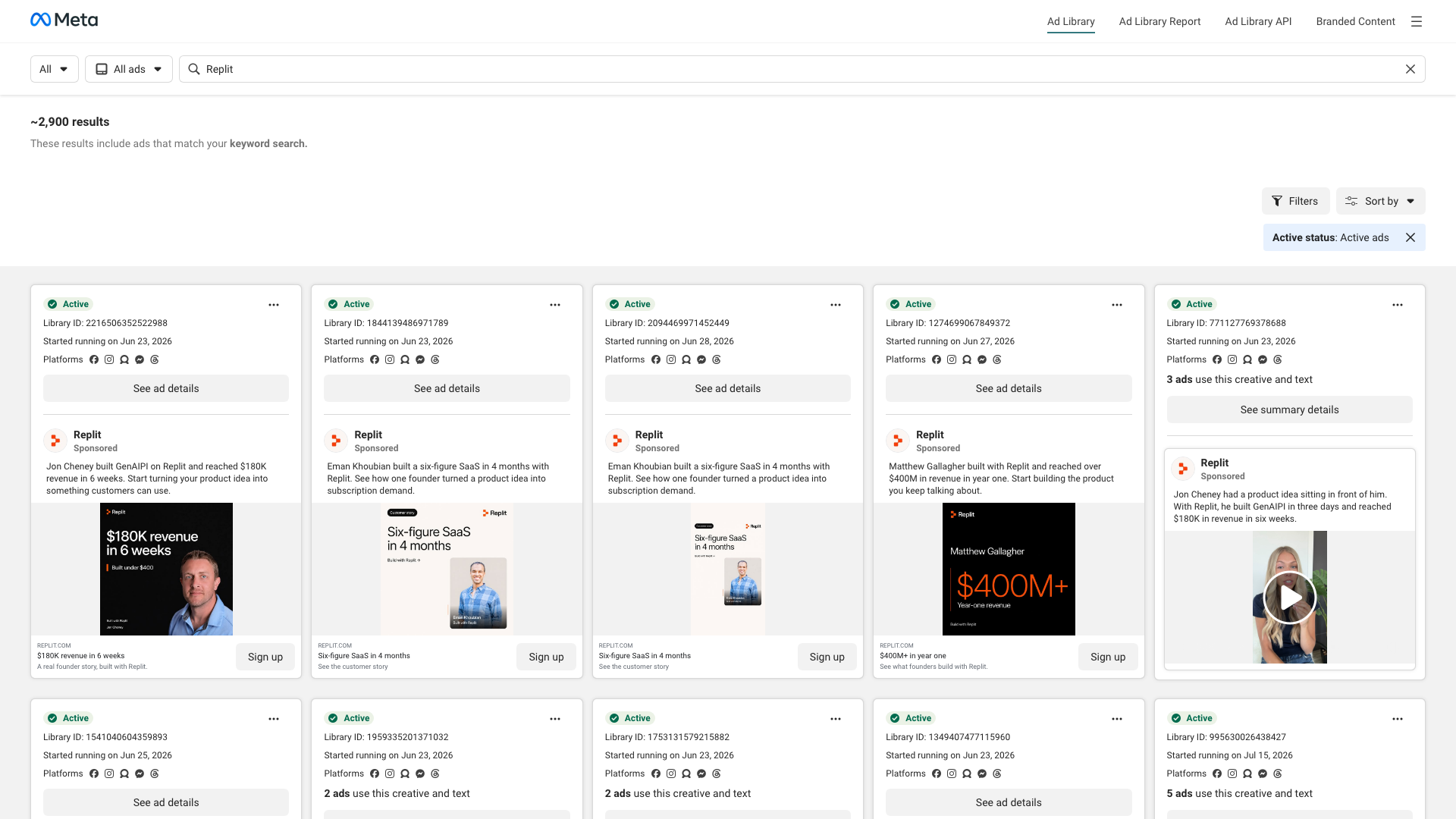
Real ads on file: Replit's Google search ad, live since Jan 2025 — ~408 verified days · Teachable category-promise text, 1,477 days.
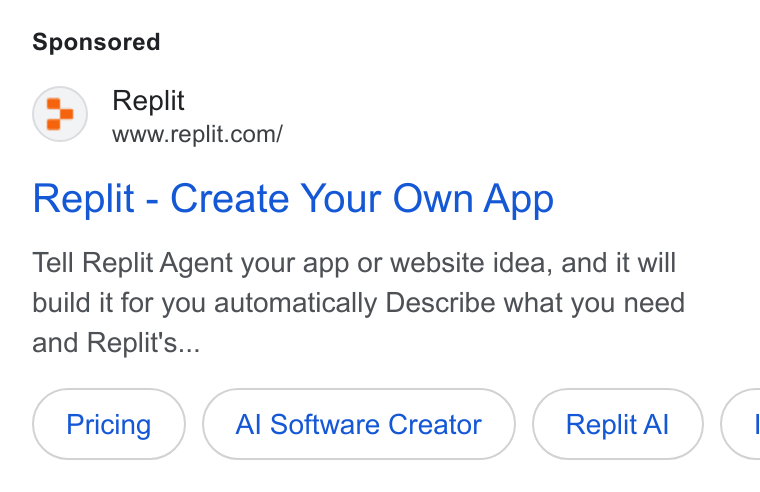
Replit, live since Jan 2025. "Tell Replit Agent your app or website idea, and it will build it for you automatically." 408 days of continuous spend: plain beats clever.
Natural
Premium register, zero production cost, unmined on Meta.
15
The statistic newdesk
One large number as the hero — an aggregate outcome, no customer name needed.
Numbers read as facts before words read as claims. Mighty Networks runs this today with zero permissions: platform-level aggregates doing the proof work testimonials usually do. Our approved set: 20K businesses / 15M members / 70k reviews.
Real ad on file: Mighty Networks' stat card, 139 days.

Mighty Networks, Google display. "4.1x ROI" — creators on the entry plan average $4,800/yr. Aggregate proof, no releases, no names.
Natural
Approved aggregates only — revenue totals stay out of creative.
16
The founder letter desk
A signed, dated letter from Andy or Sid — why we built this for coaches — set like correspondence.
The named-guide device promoted to the ad itself. A signature converts a claim into a person staking a reputation — and no info-marketer can counterfeit a real platform founder.
On file: Noom — body copy on a flat ground, no image at all, signed "With you every step, The Noom Team." A team letter rather than a founder's, but it proves the form still runs on Meta in 2026.
Natural
Human-connection doctrine, rule 18, as creative.
17
Print-style editorial desk
The ad art-directed as a magazine page — serif headline, considered layout, a pull quote.
Costume borrowed from publishing: the layout claims this was worth printing. Reads as pastiche when the writing underneath is ad copy — but a direct competitor has proven the species in our category for 586 days.
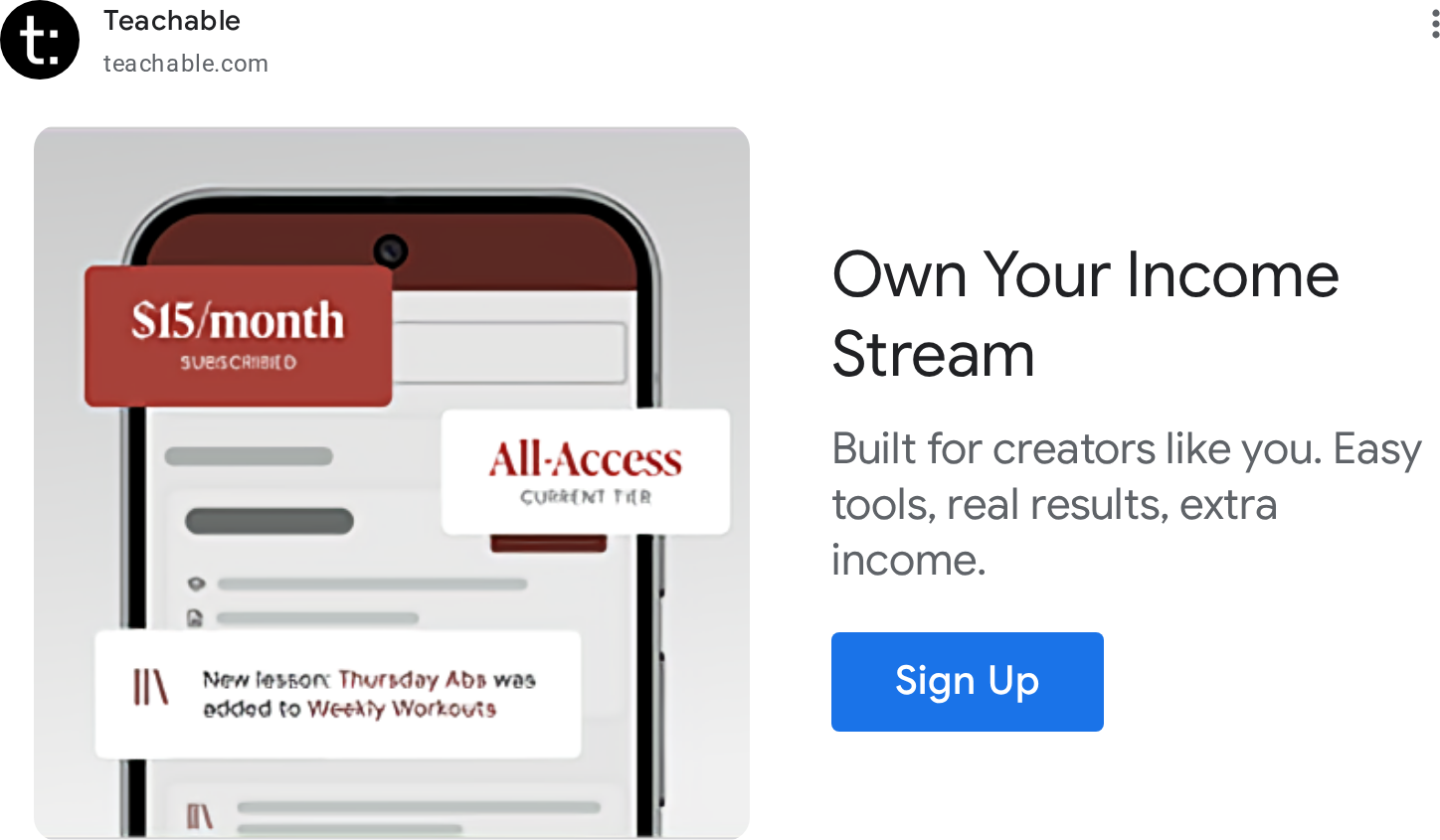
Real ad on file: Teachable's serif editorial card, 586 days.

Teachable, 586 days. "Education businesses built on real-world experience." Serif on maroon — type-only editorial earning its run in our exact market.
Natural
In-category proof upgraded this from stretch — execution quality is the whole risk.
18
Comparison ledger / switcher desk
The honest two-column: her current five-tool stack vs one platform — or the direct "vs" ad.
The single longest-running species in the coach economy. Teachable's "vs Podia" search ad is 1,740 days old and still live; Kajabi's "Switch to Kajabi" ran 1,462; Podia attacks Kajabi on price by name today. The nuance: those are search ads — the buyer named the competitor first. In feed, the premium version is the generic stack ledger, never a named takedown.
Real ad on file: Teachable vs Podia — 1,740 days, live.

Teachable, live since 2021. "Create & Sell Your Course Now — Teachable vs Podia." Nearly five years of continuous spend on one comparison ad.
Natural
Natural in search where she named the competitor; generic-stack-only in feed.